Startup GTM Sprint: Transition from Random Wins to a Predictable Sales Engine
Break the "feast-and-famine" cycle. Gain ICP clarity, high-impact messaging, and 8–10 Sales Qualified Leads (SQLs) in just 90 days with the GroRev SalesNair GTM Sprint.
SALES MASTERYGROWTH STRATEGY
Shyam Nair
4/2/202620 min read
Why Early-Stage Startups Struggle with Consistent Sales Growth
If you are an early-stage founder, this story probably sounds familiar.
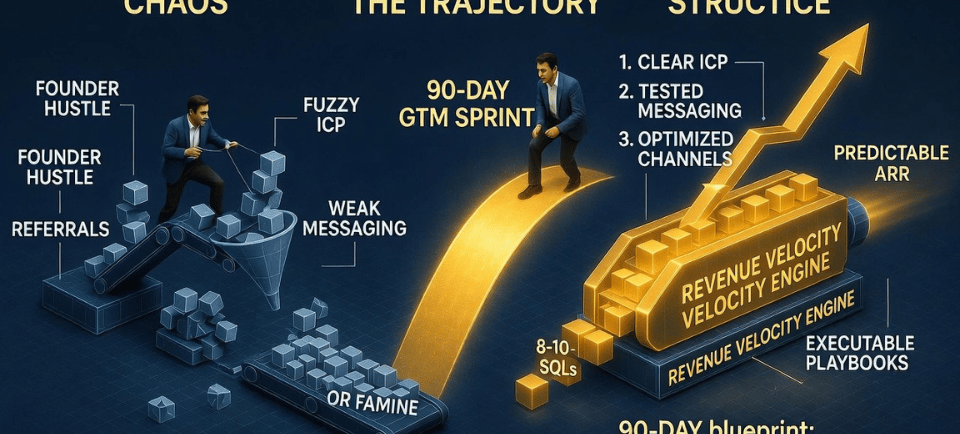
One month, you close two or three solid deals. Your pipeline feels full, and you finally start thinking that your startup sales growth is on track. Then, the next month hits. The phones go quiet. Deals that looked "guaranteed" suddenly stall. Before you know it, you are back at square one, wondering where the next lead will come from.
This is the Feast and Famine Sales Cycle. It is a brutal rollercoaster that drains your momentum, frustrates your team, and—most importantly—scares off potential investors.
The Growth Ceiling
So, why does this happen? Why do so many promising startups fail to build consistent, predictable sales growth?
The problem is rarely the product. Usually, the issue is that the company is relying on "heroics" rather than a system. When growth depends on a single person or a lucky streak of referrals, it is not a business. It is a series of fortunate events. To scale, you have to move past the chaos and build an engine that works even when you aren't the one turning the key.
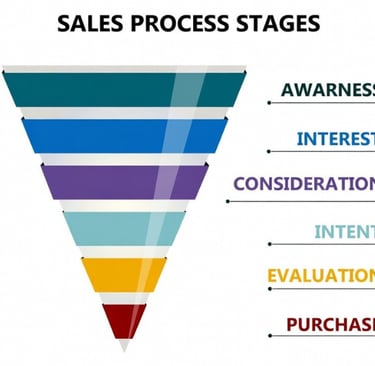
Why Referrals and Founder Hustle Do Not Scale
In the early stages, most startups grow through sheer willpower. You leverage personal networks. Former colleagues make introductions. Friends of friends take meetings. It works at first. You close your early customers and feel the initial spark of traction.
However, there is a hidden ceiling to this approach. Once that initial circle of contacts dries up, the pipeline goes flat.
The Unreliability of Referrals
Referrals are high-quality, but they are unpredictable. You cannot control when they arrive or whether they fit your Ideal Customer Profile (ICP). Relying on them creates "nice wins" without building a reliable foundation for B2B customer acquisition.
The Founder Bottleneck
No one pitches a product better than the founder. But when you are the only salesperson, everything depends on your personal time and energy. Time is the one asset you do not have in abundance. To scale, your product needs a repeatable growth system that functions independently of your daily involvement.
The Missing Piece: A Structured Go-to-Market (GTM) Motion
The real reason early-stage startups struggle with sales pipeline consistency is the lack of a structured GTM system. Without it, growth is just guesswork. You end up with:
Vague ICPs: When you try to sell to everyone, you resonate with no one.
Weak Messaging: Generic pitches that fail to address specific decision-maker pain points.
Unaligned Channels: Scattered outreach across LinkedIn or email without a clear focus.
Missing Playbooks: SDRs are hired but have no scripts, sequences, or strategic direction.
Zero Validation: Launching campaigns without testing if the messaging actually converts.
The result is a collection of random wins and a frustrated leadership team stuck in a sales cycle that never evolves.
Breaking the Cycle with a 90-Day GTM Sprint
Breaking out of the "Feast and Famine" cycle does not require years of trial and error. It requires a focused effort to validate your GTM and install a professional structure.
At GroRev SalesNair, we created the Startup GTM Sprint to bridge this gap. In just 90 days, we deliver:
Precision Targeting: Defined ICPs and detailed buyer personas.
Resonant Messaging: Frameworks tailored to solve actual customer pain points.
Execution Assets: Outbound and inbound playbooks ready for immediate use.
Market Proof: A live pilot campaign targeting 500 to 1,000 accounts to deliver 8 to 10 SQLs.
The ultimate result is Predictable Growth Confidence. You stop guessing and start winning because you finally have proof that your GTM system works. Early stage growth fails when the system is missing. Referrals get you started, but a structured engine gets you to scale.
👉 Explore how the Startup GTM Sprint can validate your pipeline in 90 days
The 90-Day Blueprint to Break the Feast and Famine Cycle
Most founders underestimate how fast they can validate their go-to-market system. They imagine years of trial, error, and expensive hires before a pipeline becomes predictable. The reality is very different. With the right framework, you can create clarity and market proof in just 90 days.
The Startup GTM Sprint is designed to deliver live results in three months. Instead of theoretical strategy decks, it focuses on five core service areas that build a foundation for growth you can actually trust.
1. ICP and Buyer Persona Precision
You cannot sell to everyone. Startups often chase too many markets, which wastes time and dilutes energy. We begin by defining a clear Ideal Customer Profile. We segment your market by funding stage, revenue size, geography, and industry. We then create detailed buyer personas that map out roles, pain points, and decision-making styles. This ensures you only spend resources on high-priority accounts.
2. Value Proposition and Messaging Architecture
Once you know your target, you must speak their language. Generic messaging fails to resonate with busy executives. During the Sprint, we architect value propositions that align with real-world pain points. We craft a core positioning statement, a high-impact elevator pitch, and persona-specific frameworks. These email and LinkedIn templates ensure your outreach connects directly to a customer's urgent needs.
3. Optimized Channel Mix Strategy
Startups often spread their efforts too thin across too many platforms. We identify the specific channels that matter most for your ICP. Whether it is cold email, LinkedIn social selling, or targeted content, we assess what works. We then design a 90-day calendar to ensure consistent engagement and eliminate wasted effort on low-performing channels.
4. Integrated Outbound and Inbound Playbooks
High-level strategy requires tactical execution. We provide your team with ready-to-use playbooks:
Outbound Playbooks: Cold email sequences, LinkedIn scripts, and cold call frameworks with live objection handling notes.
Inbound Playbooks: Professional landing page copy, a 90-day content calendar, and lead magnet templates such as checklists or mini-guides.
5. Pilot Outreach Campaign Execution
Strategy means nothing without proof. This is why the GroRev SalesNair Sprint includes a live pilot campaign. We build a verified list of 500 to 1,000 accounts aligned to your ICP. We set up the automation tools, manage the outreach, and track performance weekly. The target outcome is 8 to 10 Sales Qualified Leads (SQLs) in 90 days. This validates your GTM motion with tangible results.
Confidence Through Market Proof
The biggest outcome of this 90-day blueprint is Executive Confidence. You stop guessing who to target and start knowing which channels work. You walk away with a tested system that proves your startup can generate pipeline on demand.
If you are ready to break free from the feast and famine cycle, the Startup GTM Sprint provides the clear path. In just 90 days, you move from guesswork to structured, scalable growth.
👉 [Explore how the Sprint works and see how it delivers SQLs for your startup]
ICP and Messaging Mistakes That Kill Startup Sales
The old saying is true. If you sell to everyone, you sell to no one. This is one of the primary reasons early stage startups struggle with sales consistency. Founders often believe that casting a wide net will maximize their opportunities. In reality, it creates confusion and wasted effort. Without a clear Ideal Customer Profile (ICP) and sharp messaging, your sales team is simply spinning its wheels.
Common ICP and Messaging Pitfalls
Mistake 1: Defining the ICP Too Broadly: Many founders describe their target audience in vague terms like "SMBs in tech" or "mid-market companies." These categories are too wide to be actionable. Your ICP must identify who is most likely to buy right now. You must narrow your field by funding stage, revenue size, geography, and specific industry. A broad ICP leads to reaching out to companies with no urgency, which results in longer sales cycles and lower win rates.
Mistake 2: Ignoring the Buyer Persona: An ICP defines the company. A buyer persona identifies the human decision-maker. Many startups stop at the company level and forget the individual. A CTO cares about scalability. A COO cares about efficiency. A Founder cares about survival and growth. If your messaging does not address these personal goals, your outreach will feel generic and will be ignored.
Mistake 3: Leading With Product Features: Buyers do not care about features until they believe the product solves their specific problem. Messaging must focus on business outcomes. Instead of saying "our platform automates workflows," a stronger pitch is "we cut your reporting time by 40 percent." Buyers respond to results that impact their bottom line.
Mistake 4: Copy-Paste Messaging Across Channels: Email, LinkedIn, and cold calls require different tones and approaches. Reusing the same copy everywhere reduces your impact and lowers response rates. Your messaging must adapt to the specific channel while keeping the core value proposition consistent.
Case Study: The EdTech SaaS Pivot
An EdTech SaaS platform we worked with had strong early adoption but lacked a repeatable sales motion. Their ICP was too broad, including every university and school. This made their campaigns expensive and ineffective. Their messaging focused heavily on product features rather than the pain points of admissions teams.
During the Startup GTM Sprint, we narrowed their ICP to universities specifically struggling with digital admissions. We created buyer personas for Admissions Directors and IT leads. We then built messaging frameworks focused on reducing manual workloads and improving the student experience.
The Result: Within 90 days, they generated 12 SQLs and converted three pilot customers, creating a $250K pipeline.
Fixing Your Foundation in 30 Days
These mistakes can be fixed quickly. The first 30 days of the Startup GTM Sprint focus entirely on ICP clarity and messaging frameworks. By the end of the first month, you will know exactly which accounts to target and exactly what to say to decision-makers. With a sharp foundation, every campaign that follows becomes more effective.
Early-stage sales fail when the ICP is fuzzy and the messaging is generic. If you want faster traction, start with clarity.
👉 Explore how GroRev SalesNair fixes ICP and messaging in the first 30 days
Why SDRs Fail in Early-Stage Startups (and How to Fix It)
The 90-day SDR turnover is a common headache for early-stage founders. You hire a fresh Sales Development Representative (SDR) with high hopes for pipeline growth. Within three months, the hire underperforms or leaves. The cycle repeats. You get frustrated, your pipeline dries up, and capital is wasted.
This rarely happens because of a lack of talent. The problem lies in the environment. Most SDRs fail because they are dropped into a "sink or swim" scenario without a life jacket.
The Three Pillars of SDR Failure
Lack of Tactical Training: Many startups expect SDRs to figure out the sales motion on their own. A new hire receives a product demo and a prospect list but zero guidance on how to actually open a conversation. Without knowing how to ask the right questions or handle objections, an SDR will struggle and lose confidence fast.
Missing Execution Playbooks: An SDR without a playbook is like a pilot without a flight plan. You cannot assume an SDR will create their own messaging. This leads to inconsistent outreach and low-quality conversations. You need structured outbound playbooks that include verified email sequences, LinkedIn scripts, and call frameworks.
No Accountability or Structure: SDRs fail when there is no structure around their daily work. This includes a missing CRM setup, vague activity targets, and no reporting rhythm. Without a defined sales stack and daily benchmarks, the SDR spends time on random tasks with no visibility into what actually drives results.
Research from Gartner highlights that poor role clarity is a key driver of sales underperformance.
Fixing the SDR Turnover Problem in 90 Days
You do not need to lose an SDR every three months. You need a system that sets them up for success from day one. This is a core component of the Startup GTM Sprint. Within the first 90 days, we provide the infrastructure your team needs:
Ready-to-Use Playbooks: High-conversion email sequences and LinkedIn scripts that remove the guesswork.
ICP Clarity: Definitive messaging frameworks so your SDRs know exactly who to target and what to say.
Proven Systems: A structured sales stack and activity dashboards to track SQLs and performance.
Market Validation: Pilot campaigns that generate 8 to 10 SQLs, proving to the SDR that the system actually works.
When you provide tools and structure, you replace guessing with confidence. You stop worrying about turnover and start focusing on closing the deals your team brings to you.
SDRs do not fail because they cannot sell. They fail because the environment sets them up to fail. Once the structure is in place, the pipeline grows.
👉 [Explore how the Startup GTM Sprint equips your team with playbooks that work]
The Power of a Pilot Campaign: Proof Over Theory
Founder, you can build the most impressive strategy deck in the world. You can design complex ICPs, craft beautiful messaging, and map out intricate GTM motions. However, none of it matters until you test it in the market. Plans are just assumptions until they meet the real world. That is why a pilot campaign is the most critical part of your growth strategy.
Why a Pilot Campaign Works
A pilot campaign is a 90-day experiment that moves your value proposition from the boardroom to the buyer. Instead of endless planning, you get immediate proof. Within 90 days, you will finally know:
Messaging Resonance: Do your prospects actually respond to your value proposition?
ICP Validation: Are you targeting the accounts most likely to sign a contract?
Channel Efficiency: Which channels drive the most meetings and qualified replies?
Sales Velocity: How long is your sales cycle in a real-world setting?
This is the fastest way to move from theory to evidence.
How We Validate Your GTM Strategy
A pilot campaign strips your GTM down to the essentials to find what works. We build one focused list of high-priority ICP accounts and launch a multi-channel outreach sequence across email, LinkedIn, and phone. We track every response and meeting booked. Most importantly, we adjust your messaging every two to three weeks based on the data we collect. By the end of 90 days, you have the data to know what to scale and what to discard.
Case Study: Market Research SaaS
One founder we worked with built a brilliant platform for automated market research. Their challenge was a total lack of proof that their target market would actually engage. We designed a 90-day pilot campaign targeting mid-sized consulting firms and insights teams in North America. We focused the messaging on faster turnarounds and 30% cost savings.
The Results After 90 Days:
250 targeted accounts.
42 meetings booked.
9 qualified opportunities.
3 deals closed within the pilot window.
The founder finally had proof. The ICP was validated, the messaging resonated, and the sales motion was proven to be repeatable.
Why Proof Beats Theory
Investors, partners, and your own sales team respond better to data than to slides. A pilot campaign gives you that data. It also saves you months of debating strategies. You get your answers in the market.
Through the GroRev SalesNair GTM Sprint, we run these pilot campaigns for you. In 90 days, you see 8 to 10 SQLs, real-world data on your ICP fit, and a repeatable motion you can scale. Proof beats theory every time.
👉 Start your GTM Pilot Campaign with GroRev SalesNair
Preparing for Fundraising? Investors Want a Predictable Pipeline
Funding is not just about a high-quality product or a massive Total Addressable Market (TAM). At the Seed and Series A stages, investors want proof that you can turn a market opportunity into consistent revenue. That proof comes from a repeatable go-to-market system.
Many founders walk into fundraising conversations armed with product demos and financial projections. These elements are important, but they are not enough to close a round. What convinces investors is clear evidence that you can generate a qualified pipeline again and again. Without this, your growth story feels fragile and high-risk.
Why Investors Prioritize Predictable Pipelines
Investors know that products mature and markets shift. They are looking for confidence that your startup has mastered the art of customer acquisition. A predictable pipeline proves four critical things:
Precision: You know exactly who your buyers are.
Access: You understand the specific channels to reach them.
Resonance: Your messaging consistently converts decision-makers.
Consistency: You produce regular SQLs instead of relying on "lucky" random wins.
This evidence reduces risk. It shows that their capital will not just fund R&D, but will act as fuel for a growth engine that already works.
The Scalability Problem with Founder-Led Sales
Early traction often comes from sheer founder hustle. You leverage your personal network and close the first ten deals through willpower. While this is necessary at the start, it does not scale. Investors know that if growth depends entirely on your personal energy, the business is not yet sustainable. To raise successfully, you need a system that can win the next hundred customers without your constant intervention.
Repeatability: From Vision to Execution
A repeatable GTM motion proves that your growth is not an accident. You can show a massive TAM, but if you cannot explain exactly how you will capture it, investors see a gap in execution. A GTM motion replaces "hope" with "execution." That is what professional investors pay for.
How the Startup GTM Sprint Builds Investor Confidence
We created the Startup GTM Sprint to help founders raise with a position of strength. In just 90 days, you walk away with:
Verified Assets: Defined ICPs and tested buyer personas.
Market-Tested Frameworks: Messaging that is already proven to convert.
Ready-to-Scale Playbooks: Outbound and inbound systems your team can use immediately.
Tangible Results: A pilot campaign delivering 8 to 10 SQLs.
Most importantly, you leave with a GTM story backed by live market results. Instead of telling investors what you plan to do, you show them what is already working. Funding rounds are won with proof.
👉 Build investor confidence with the GroRev SalesNair GTM Sprint
Founder-Led Sales vs. Founder-Led Growth Systems
Founder, let us be honest. You should be selling. Nobody sells your product better than you do. Your conviction, your story, and your deep knowledge of the problem space are your greatest assets. No SDR or Account Executive can match that level of insight in the early days.
However, there is a significant danger in this approach. Founders who stay stuck in every stage of the sales process eventually create a growth ceiling. If every lead, every demo, and every follow-up requires your personal intervention, then your company's growth is strictly limited by your calendar.
The Early Stage Reality: Founder-Led Sales
In the beginning, founder-led sales is not optional. It is how you learn the market's objections. It is how you sharpen the pitch and prove that customers will actually pay. The problem starts when you continue to do every role. Prospecting, cold emailing, qualifying, and booking meetings. This is not a sustainable business model. It is simply a founder acting as an SDR.
The Critical Shift: From Prospector to Strategic Closer
To scale, you must move from being the primary prospector to becoming the primary closer. A structured system allows for a clear division of labor:
SDRs and Systems: Build the pipeline, qualify prospects, and book the meetings.
Founders: Step in for high-value conversations. Run discovery with key accounts. Close strategic deals and influence the biggest opportunities.
When you make this shift, your pipeline no longer depends on your late-night LinkedIn messages. Your time finally focuses only on the deals that move the needle.
Founder-Led Growth Systems: Freedom from the Grind
This is where a system replaces chaos. Instead of you chasing every lead, the system brings qualified meetings to you. Your messaging is documented in a playbook. Your CRM tracks every stage. You enter the conversation only when the deal is strategic enough to demand your presence. This is the difference between a sales process that traps you and a growth system that frees you.
Why Scaling Requires This Maturity
Investors and partners look for proof of a scalable sales motion. If a founder is still cold-calling in year two, it signals a high level of risk. If a founder is closing enterprise deals supported by a team-driven pipeline, it signals scalability. Your job is not to stop selling. Your job is to keep selling where your impact is the highest.
The GroRev SalesNair Sprint Advantage
Our Startup GTM Sprint is designed to free you from the SDR grind. In just 90 days, you get a working pipeline, a trained SDR motion, and total clarity on where your personal sales effort should focus. You should sell, but not forever. We build the system that lets you step up to high-value deals while your team keeps the pipeline full. HubSpot data suggests that consistent training and onboarding directly impact SDR performance
Stop being the engine. Start being the pilot.
👉 Free yourself from the sales grind with a GroRev SalesNair GTM Sprint
Funding is not just about a high-quality product or a massive Total Addressable Market (TAM). At the Seed and Series A stages, investors want proof that you can turn a market opportunity into consistent revenue. That proof comes from a repeatable go-to-market system.
Many founders walk into fundraising conversations armed with product demos and financial projections. These elements are important, but they are not enough to close a round. What convinces investors is clear evidence that you can generate a qualified pipeline again and again. Without this, your growth story feels fragile and high-risk.
Why Investors Prioritize Predictable Pipelines
Investors know that products mature and markets shift. They are looking for confidence that your startup has mastered the art of customer acquisition. A predictable pipeline proves four critical things:
Precision: You know exactly who your buyers are.
Access: You understand the specific channels to reach them.
Resonance: Your messaging consistently converts decision-makers.
Consistency: You produce regular SQLs instead of relying on "lucky" random wins.
This evidence reduces risk. It shows that their capital will not just fund R&D, but will act as fuel for a growth engine that already works.
The Scalability Problem with Founder-Led Sales
Early traction often comes from sheer founder hustle. You leverage your personal network and close the first ten deals through willpower. While this is necessary at the start, it does not scale. Investors know that if growth depends entirely on your personal energy, the business is not yet sustainable. To raise successfully, you need a system that can win the next hundred customers without your constant intervention.
Repeatability: From Vision to Execution
A repeatable GTM motion proves that your growth is not an accident. You can show a massive TAM, but if you cannot explain exactly how you will capture it, investors see a gap in execution. A GTM motion replaces "hope" with "execution." That is what professional investors pay for.
How the Startup GTM Sprint Builds Investor Confidence
We created the Startup GTM Sprint to help founders raise with a position of strength. In just 90 days, you walk away with:
Verified Assets: Defined ICPs and tested buyer personas.
Market-Tested Frameworks: Messaging that is already proven to convert.
Ready-to-Scale Playbooks: Outbound and inbound systems your team can use immediately.
Tangible Results: A pilot campaign delivering 8 to 10 SQLs.
Most importantly, you leave with a GTM story backed by live market results. Instead of telling investors what you plan to do, you show them what is already working. Funding rounds are won with proof.
👉 Build investor confidence with the GroRev SalesNair Market Sizing Toolkit
From Guesswork to Growth: The Confidence Every Founder Needs
Confidence is not built on hustle. It is built on clarity.
Many early-stage founders confuse energy with progress. They push harder, work longer hours, and chase every lead that comes their way. Hustle feels good for a while, but it rarely creates predictable results. Confidence in growth does not come from how much you work, it comes from knowing exactly where to focus and how to win.
That is why clarity on your Ideal Customer Profile, your messaging, and your system for generating pipeline matters more than effort.
The Problem With Guesswork
When founders operate without structure, sales feel random. One month brings new customers, the next month nothing arrives. The pipeline becomes a rollercoaster that drains energy and scares investors. This feast and famine cycle happens because founders are guessing. Guessing who to target. Guessing what to say. Guessing which channels will work.
Guesswork does not scale. What founders need is a way to remove uncertainty.
Where Confidence Comes From
Confidence comes from proof. When you can say, “We know our ICP. We know our messaging works. We know our system delivers SQLs,” everything changes.
Investors see less risk.
SDRs know exactly what to do.
Founders stop living in panic mode.
Clarity removes doubt and allows teams to operate with focus. Instead of trying everything, you double down on what works. That is the foundation of predictable growth.
How the Startup GTM Sprint Creates Clarity
The Startup GTM Sprint was designed for this exact reason. In 90 days, you move from guesswork to growth by focusing on five core areas:
ICP and Buyer Personas – You stop chasing everyone and focus on high-potential segments.
Messaging Frameworks – You stop pitching features and start speaking to decision-maker pain points.
Channel Mix Design – You stop spreading efforts thin and focus on channels that work.
Outbound and Inbound Playbooks – You stop improvising and start executing with precision.
Pilot Campaign Execution – You stop theorizing and see proof with 8 to 10 SQLs in 90 days.
This is not a strategy deck. It is a sprint that gives you real results. By the end, you do not just have documents. You have live proof that your GTM system works.
The Confidence Every Founder Needs
The biggest outcome of the Sprint is confidence. The confidence to walk into investor meetings with a clear GTM story. The confidence to build a sales team that follows proven playbooks. The confidence to focus on closing deals instead of worrying about pipeline.
Confidence is not about working harder. It is about knowing your growth system works.
If you are an early-stage founder tired of guessing, it is time to shift to clarity. Book your Growth Diagnostic Call today and see how the Startup GTM Sprint can give you the confidence to grow with proof, not hope.
👉 Book Your Growth Diagnostic Call Today
Founder, let us be honest. You should be selling. Nobody sells your product better than you do. Your conviction, your story, and your deep knowledge of the problem space are your greatest assets. No SDR or Account Executive can match that level of insight in the early days.
However, there is a significant danger in this approach. Founders who stay stuck in every stage of the sales process eventually create a growth ceiling. If every lead, every demo, and every follow-up requires your personal intervention, then your company's growth is strictly limited by your calendar.
The Early Stage Reality: Founder-Led Sales
In the beginning, founder-led sales is not optional. It is how you learn the market's objections. It is how you sharpen the pitch and prove that customers will actually pay. The problem starts when you continue to do every role. Prospecting, cold emailing, qualifying, and booking meetings. This is not a sustainable business model. It is simply a founder acting as an SDR.
The Critical Shift: From Prospector to Strategic Closer
To scale, you must move from being the primary prospector to becoming the primary closer. A structured system allows for a clear division of labor:
SDRs and Systems: Build the pipeline, qualify prospects, and book the meetings.
Founders: Step in for high-value conversations. Run discovery with key accounts. Close strategic deals and influence the biggest opportunities.
When you make this shift, your pipeline no longer depends on your late-night LinkedIn messages. Your time finally focuses only on the deals that move the needle.
Founder-Led Growth Systems: Freedom from the Grind
This is where a system replaces chaos. Instead of you chasing every lead, the system brings qualified meetings to you. Your messaging is documented in a playbook. Your CRM tracks every stage. You enter the conversation only when the deal is strategic enough to demand your presence. This is the difference between a sales process that traps you and a growth system that frees you.
Why Scaling Requires This Maturity
Investors and partners look for proof of a scalable sales motion. If a founder is still cold-calling in year two, it signals a high level of risk. If a founder is closing enterprise deals supported by a team-driven pipeline, it signals scalability. Your job is not to stop selling. Your job is to keep selling where your impact is the highest.
The GroRev SalesNair Sprint Advantage
Our Startup GTM Sprint is designed to free you from the SDR grind. In just 90 days, you get a working pipeline, a trained SDR motion, and total clarity on where your personal sales effort should focus. You should sell, but not forever. We build the system that lets you step up to high-value deals while your team keeps the pipeline full.
Stop being the engine. Start being the pilot.
👉 Free yourself from the sales grind with a GroRev SalesNair GTM Sprint
Funding is not just about a high-quality product or a massive Total Addressable Market (TAM). At the Seed and Series A stages, investors want proof that you can turn a market opportunity into consistent revenue. That proof comes from a repeatable go-to-market system.
Many founders walk into fundraising conversations armed with product demos and financial projections. These elements are important, but they are not enough to close a round. What convinces investors is clear evidence that you can generate a qualified pipeline again and again. Without this, your growth story feels fragile and high-risk.
Why Investors Prioritize Predictable Pipelines
Investors know that products mature and markets shift. They are looking for confidence that your startup has mastered the art of customer acquisition. A predictable pipeline proves four critical things:
Precision: You know exactly who your buyers are.
Access: You understand the specific channels to reach them.
Resonance: Your messaging consistently converts decision-makers.
Consistency: You produce regular SQLs instead of relying on "lucky" random wins.
This evidence reduces risk. It shows that their capital will not just fund R&D, but will act as fuel for a growth engine that already works.
The Scalability Problem with Founder-Led Sales
Early traction often comes from sheer founder hustle. You leverage your personal network and close the first ten deals through willpower. While this is necessary at the start, it does not scale. Investors know that if growth depends entirely on your personal energy, the business is not yet sustainable. To raise successfully, you need a system that can win the next hundred customers without your constant intervention.
Repeatability: From Vision to Execution
A repeatable GTM motion proves that your growth is not an accident. You can show a massive TAM, but if you cannot explain exactly how you will capture it, investors see a gap in execution. A GTM motion replaces "hope" with "execution." That is what professional investors pay for.
How the Startup GTM Sprint Builds Investor Confidence
We created the Startup GTM Sprint to help founders raise with a position of strength. In just 90 days, you walk away with:
Verified Assets: Defined ICPs and tested buyer personas.
Market-Tested Frameworks: Messaging that is already proven to convert.
Ready-to-Scale Playbooks: Outbound and inbound systems your team can use immediately.
Tangible Results: A pilot campaign delivering 8 to 10 SQLs.
Most importantly, you leave with a GTM story backed by live market results. Instead of telling investors what you plan to do, you show them what is already working. Funding rounds are won with proof.
👉 Build investor confidence with the GroRev SalesNair GTM Sprint
Your Sales Growth Partner
Subscribe
sales@salesnair.com
+91-836-877-0579
© 2026. All rights reserved.
GroRev SalesNair